Gas Safety Inspection Commercial Catering Appliances Certificate (CP42)
The most common commercial gas safety certificate — covering all catering appliances in professional kitchens. Restaurants, cafés, takeaways, hotels, and more.
 Officially Registered
What is a CP42 Certificate?
The CP42 is the most common commercial gas safety certificate. It covers all commercial catering gas appliances found in professional kitchens, including cookers, fryers, grills, ovens, bain-maries, salamanders, and water heaters.
The CP42 certificate is specifically for commercial catering gas appliances found in professional kitchens.
This is one of the most commonly required certificates for restaurants, cafes, takeaways, hotels, and any premises with commercial catering equipment.
Our engineers inspect all commercial catering gas appliances including cookers, grills, fryers, ovens, and water heaters to ensure they are safe and in good working order.
The inspection covers gas supply, appliance operation, flue systems, ventilation, and emergency controls. Each appliance is individually tested and recorded on the certificate.
Why Do You Need a CP42 Certificate?
Environmental Health Officers routinely ask to see a valid CP42 certificate when inspecting food premises. Without one, your business may be forced to close until a certificate is obtained. Insurance companies also require valid gas safety certificates.
📋 Legal Requirement
Under the Gas Safety (Installation and Use) Regulations 1998 and the Health and Safety at Work Act 1974, employers have a duty to maintain gas equipment and ensure it is safe. Annual gas safety inspections are a legal requirement for commercial catering premises.
🔄 How Often?
Every 12 months. Many insurers and local authorities recommend more frequent checks for busy kitchens.
Gas Appliances Covered & Required Qualifications
Each appliance type requires the engineer to hold a specific ACS (Accredited Certification Scheme) qualification on their Gas Safe registration. Our engineers hold all of the qualifications listed below.
| Appliance | Gas Safe Qualification Required |
|---|---|
| Commercial range cooker (6-burner, 8-burner) | CCCN1 + COMCAT1 (Atmospheric Burners / Ranges) |
| Commercial oven (convection / fan-assisted) | CCCN1 + COMCAT5 (Forced Draught Burner Appliances) |
| Salamander grill / overhead grill | CCCN1 + COMCAT1 (Atmospheric Burners) |
| Charbroiler / chargrill | CCCN1 + COMCAT1 (Atmospheric Burners) |
| Deep fat fryer (single / double tank) | CCCN1 + COMCAT3 (Deep Fat & Pressure Fryers) |
| Griddle / flat plate grill | CCCN1 + COMCAT1 (Atmospheric Burners) |
| Bain-marie (wet / dry heat) | CCCN1 + COMCAT1 (Atmospheric Burners) |
| Tandoori oven / clay oven | CCCN1 + COMCAT1 (Atmospheric Burners) |
| Wok burner (high-output ring) | CCCN1 + COMCAT1 (Atmospheric Burners) |
| Pizza oven (gas-fired deck / conveyor) | CCCN1 + COMCAT1 (Atmospheric Burners) |
| Stockpot burner / boiling ring | CCCN1 + COMCAT1 (Atmospheric Burners) |
| Pasta cooker / boiling pan | CCCN1 + COMCAT2 (Pressure Water Boilers) |
| Combination oven (combi-steamer) | CCCN1 + COMCAT5 (Forced Draught Burner Appliances) |
| Rotisserie (gas-fired) | CCCN1 + COMCAT1 (Atmospheric Burners) |
| Kebab machine / doner grill | CCCN1 + COMCAT1 (Atmospheric Burners) |
| Commercial dishwasher (gas-heated) | CCCN1 + COMCAT5 (Forced Draught Burner Appliances) |
| Commercial water heater (instantaneous / storage) | COCN1 + CIGA1 (Indirect-fired Heating) |
| Commercial boiler (heating) | COCN1 + CIGA1 (Indirect-fired Heating) |
Who Needs This Certificate?
⚠️ What Happens Without a Valid CP42?
Operating without a valid gas safety certificate puts your business, staff, and customers at serious risk:
- ✗Premises closure by Environmental Health
- ✗Loss of food hygiene rating
- ✗Insurance claim rejection in event of fire or injury
- ✗HSE prosecution and fines
- ✗Personal liability for business owner
CP42 Inspection Checklist
Every item below is verified by our Gas Safe registered engineer during the inspection:
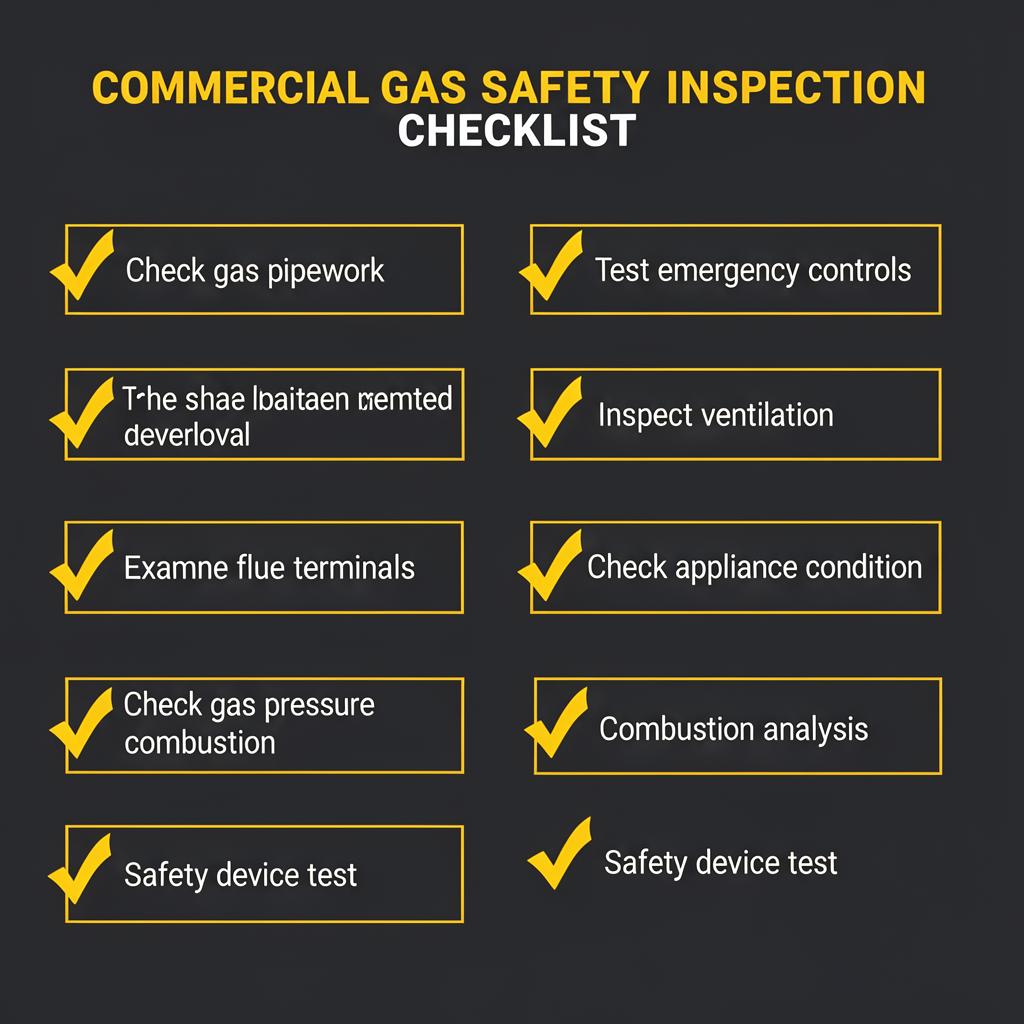
Check gas isolation valves for each appliance
Test interlock system between extraction and gas supply
Inspect gas hoses, bayonet fittings, and stability chains
Check flame failure devices on every burner
Test pilot lights and ignition systems
Inspect ventilation and extraction systems
Perform combustion analysis on each appliance
Check gas pressure at each appliance
Test emergency gas shut-off valve (red handle)
Inspect flue systems and canopy extractors
Check for signs of combustion spillage
Verify CO alarm is present and working (if installed)
Our Gas Safety Inspection Process
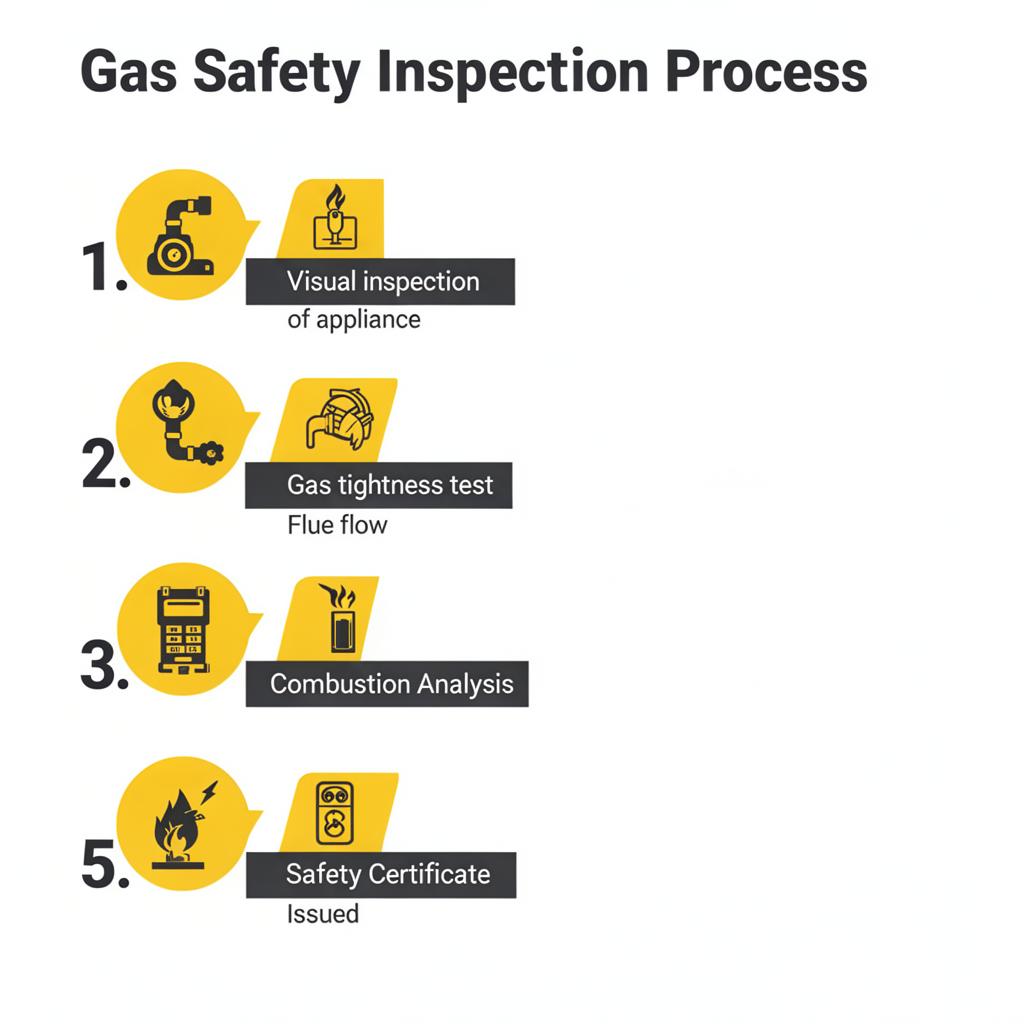
Thorough Visual Assessment
Our engineer examines every gas appliance, pipe run, and fitting for wear, corrosion, or non-compliant installation before any testing begins.
Pipework Integrity Testing
We pressurise the gas pipework downstream of the meter and monitor for any drop, confirming no leaks exist within your installation.
Flue & Ventilation Checks
We verify that all flues draw correctly and combustion gases are safely evacuated, protecting your premises from carbon monoxide build-up.
Combustion Performance Analysis
Using calibrated flue-gas analysers, we measure CO, CO₂, and O₂ concentrations to confirm each appliance burns efficiently and within safe limits.
On-the-Spot Certification
Once every check passes, your Gas Safe registered engineer issues the relevant certificate immediately — no waiting, no follow-up visits.
Scope of the Inspection — Gas Interlock & Ventilation System
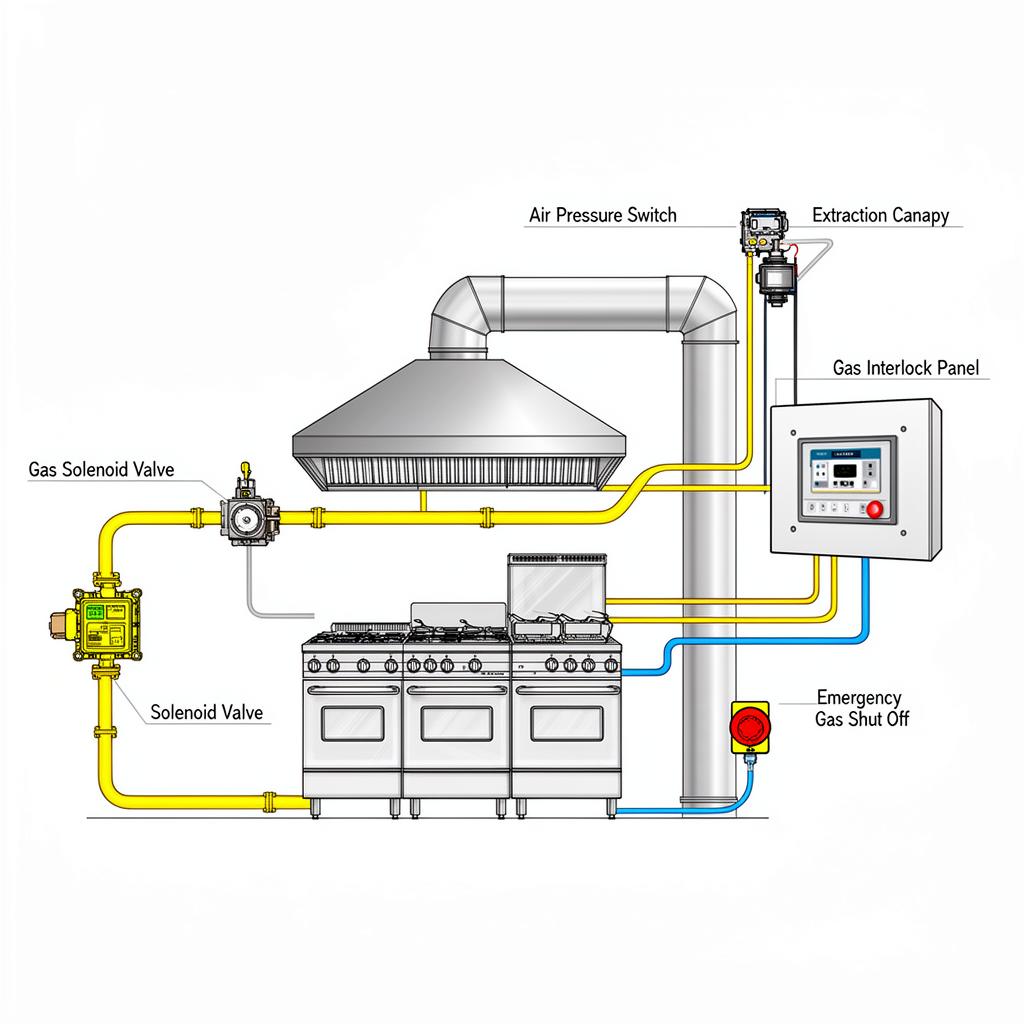
Complete Gas Interlock & Extraction System
Our engineers inspect the complete gas interlock system including the gas meter, solenoid valve, interlock control panel, extraction canopy, emergency stop controls, and ventilation system. All components must work together to ensure the gas supply is automatically shut off if the ventilation system fails.
Included in the inspection:
- ✓ Gas meter and downstream pipework to each appliance
- ✓ Gas solenoid valve operation and drop-tight testing
- ✓ Gas interlock control panel functionality and wiring
- ✓ Extraction canopy airflow rates and filter condition
- ✓ Emergency gas shut-off button (mushroom-head stop)
- ✓ Make-up air and ventilation system adequacy
- ✓ Interlock proving sequence (extraction on → gas enabled)
- ✓ All connected commercial catering appliances
- ✓ Flame failure devices and safety controls on each appliance
Not included:
- ✗ The incoming supply pipe before the meter (gas transporter's asset)
- ✗ The gas meter itself (owned by your gas supplier)
- ✗ Electrical wiring beyond the interlock panel (electrician's scope)
- ✗ Kitchen extraction ductwork cleaning (specialist contractor)
Suspect a gas leak before the meter? Call the National Gas Emergency Service on 0800 111 999 immediately — it is free and available 24/7.
Gas Interlock System Requirements (BS 6173:2020)
Under BS 6173:2020 and IGEM/UP/19, every commercial kitchen with mechanical ventilation must have a gas interlock system. The interlock ensures gas cannot flow unless the extraction system is running and providing adequate airflow. Here is how the system works and what our engineers check:
How the Gas Interlock Proving Sequence Works
Extraction fan starts — The kitchen extraction canopy fan must be switched on before any gas appliance can operate.
Air pressure switch confirms airflow — A differential air pressure switch mounted on the extraction ductwork detects that the fan is running and producing sufficient airflow. It sends a signal to the interlock panel.
Interlock panel energises the gas solenoid valve — Once the interlock panel receives confirmation of adequate airflow, it opens the gas solenoid valve, allowing gas to flow to the appliances.
If extraction fails, gas shuts off automatically — If the fan stops or airflow drops below the safe threshold, the air pressure switch de-energises, the solenoid valve closes, and gas is cut off within seconds.
Emergency stop — A red mushroom-head emergency gas shut-off button allows any staff member to manually cut the gas supply instantly in an emergency.
Required Components
- Gas solenoid valve — Must be fail-safe (closes on power failure), installed upstream of all appliance connections, and drop-tight tested annually
- Gas interlock control panel — Receives inputs from the air pressure switch and emergency stop; controls the solenoid valve
- Differential air pressure switch — Mounted on the extraction duct; proves the fan is moving sufficient air before gas is allowed
- Emergency gas shut-off button — Red mushroom-head type, located near the kitchen exit, accessible to all staff
- Make-up air supply — Replacement air must be provided to match extracted volume; without it, the system cannot function correctly
Ventilation Requirements
- Extraction rate — The canopy must extract at the rate specified by DW/172 or the appliance manufacturer, whichever is greater
- Canopy coverage — Must overhang all gas appliances by a minimum of 150mm on all sides (per BS 6173:2020)
- Grease filters — Must be in place, clean, and correctly fitted; missing or blocked filters reduce airflow and compromise the interlock
- CO₂ concentration — Must not exceed 2,800 ppm (0.28%) in the kitchen during normal operation
- Fire dampers — Ductwork fire dampers must be checked and free to operate; they must not obstruct airflow during normal use
Common Interlock System Failures We Find
Understanding Inspection Outcomes
Every appliance inspected receives one of three classifications. Knowing what each means helps you respond quickly and keep your business running safely.
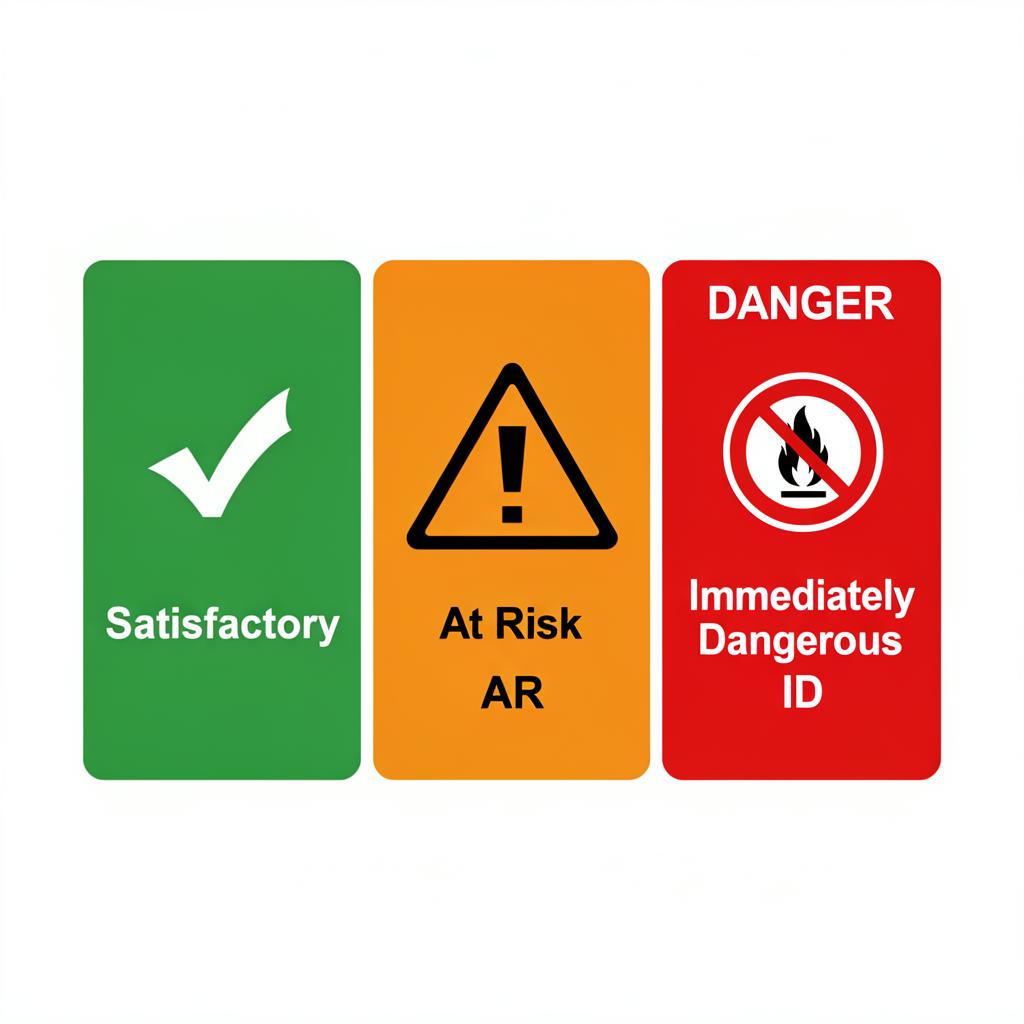
Satisfactory
The appliance meets all current standards and is safe to operate. Simply schedule your next annual check and continue trading with confidence.
At Risk (AR)
The appliance falls short of current standards but poses no immediate threat to life. Continued use is at the responsible person's discretion while remedial work is arranged promptly.
- • Ventilation below recommended levels
- • Minor flue joint deterioration
- • Overdue servicing or worn seals
- • Damaged flame supervision device
Immediately Dangerous (ID)
The appliance poses an immediate risk to life. The engineer must disconnect and isolate it on the spot. Reconnection is only permitted after a qualified repair and a fresh safety inspection.
- • Active gas leak detected
- • Blocked or severed flue
- • Dangerously high CO readings
- • Flame failure device bypassed
- • Critical ventilation deficiency
Warning Notices Explained
When a fault is identified, the engineer records it formally. Here is what each notice type means for you and your premises:
At Risk Notice
Issued when an appliance does not fully conform to current standards yet is not life-threatening. The responsible person — landlord, manager, or business owner — is informed and should arrange repairs without delay.
Practical impact: The appliance may remain in use at your own risk while repairs are scheduled. However, if you decline to act, the engineer can escalate the classification to Immediately Dangerous.
Immediately Dangerous Notice
Issued when there is a direct and immediate risk to life. The engineer disconnects and caps the gas supply to the appliance without exception.
Practical impact: The appliance is labelled "DO NOT USE" and cannot be reconnected until a Gas Safe registered engineer completes repairs, confirms safe operation, and issues a new safety record.
CP42 Certificate Pricing
Prices start from £150 + VAT for 1 gas appliance. Additional appliances are charged at £25 + VAT each.
£150
1 appliance
£175
2 appliances
£200
3 appliances
£225
4 appliances
Gas Safe Engineer Services in the UK
Our Gas Safe registered engineers cover the full range of commercial and domestic gas, boiler, heating and plumbing works in the UK.
Commercial Gas Safe Engineer in the UK
Commercial Gas Safe registered engineer in the UK — qualified across COMCAT 1–5, CODNCO1 and CORT1 for catering, plant rooms, pipework and certification.
- Full commercial Gas Safe ticket
- Catering, plant & pipework
- Same-day commercial response
Commercial Gas Safe Plumber in the UK
Commercial Gas Safe plumber in the UK — for restaurants, offices, schools and industrial premises needing combined gas, hot water and plumbing works under one engineer.
- Commercial gas + plumbing in one visit
- Catering, washroom & plant room work
- Out-of-hours scheduling
Local Gas Safe Engineer in the UK
Local Gas Safe registered engineer in the UK — fast response from an engineer who knows your area, for boiler, heating, plumbing and certificate jobs.
- Local engineer, local response times
- Domestic & light-commercial jobs
- Boiler repair, service & install
Gas Safe Boiler Engineer in the UK
Gas Safe boiler engineer in the UK for service, repair and installation of domestic and light-commercial boilers — combi, system and conventional. Worcester, Vaillant, Ideal, Baxi and more.
- Boiler service, repair & install
- Combi, system & conventional boilers
- All major brands supported
Gas Safe Heating Engineer in the UK
Gas Safe registered heating engineer in the UK — central heating installs, power-flushes, radiator replacements, smart controls and full system upgrades for homes and commercial premises.
- Full central heating design & install
- Power-flush & system clean
- Smart thermostats & zone controls
Gas Safe Plumbers in the UK
Gas Safe registered plumbers in the UK for any job that combines gas and water — boilers, hot water cylinders, gas cookers, leak repairs and plumbing emergencies.
- Gas + water specialists
- Leak detection & repair
- Hot water cylinder & unvented work
Gas Safe Installers in the UK
Gas Safe registered installers in the UK for boilers, cookers, hobs, fires and full heating systems — domestic and commercial. Notified to Gas Safe and certified on completion.
- Notified installations (Gas Safe / Building Regs)
- Boiler, cooker, hob & fire installs
- Full system upgrades
Gas Safe London in the UK
Gas Safe registered engineers across London — covering all 32 boroughs and the City. Commercial and domestic gas, boilers, heating and certificates with same-day availability.
- All London boroughs covered
- Same-day London-wide response
- Commercial & domestic engineers
Gas Safe Registered Engineer in the UK
Gas Safe Registered engineer in the UK — fully qualified, ID-carded and listed on the Gas Safe Register for any natural gas or LPG work in your home or business.
- Verified on the Gas Safe Register
- ID card available on request
- Domestic & commercial qualifications
Gas Safe Registered Heating Engineers — Central London in the UK
Gas Safe registered heating engineers covering Central London — Westminster, City, Mayfair, Soho, Marylebone, Kensington and Chelsea. Boilers, heating systems and emergency response.
- Central London priority response
- Heating system design & repair
- Listed building & period property experience
Gas Safe Registered Boiler Services in the UK
Annual boiler service by Gas Safe registered engineers in the UK — combustion check, safety device test and full service report. Keeps warranty valid and bills lower.
- Manufacturer-spec annual service
- Flue gas analysis report
- All boiler brands supported
Commercial Gas Fitter in the UK
Commercial gas fitter in the UK — pipework, meter alterations, appliance connections and full kitchen/plant room fit-outs to IGEM and BS standards.
- Steel, copper & TracPipe pipework
- Meter alterations & upgrades
- Catering & plant room fit-outs
Gas Safe Registered Plumber in the UK
Gas Safe registered plumber in the UK — verified on the Gas Safe Register for any job that combines gas and water: boilers, hot water cylinders, gas cookers, leak repair and unvented systems.
- Verified on the Gas Safe Register
- Combined gas + water specialists
- Hot water, leak & cylinder work
Independent Gas Safe Engineer in the UK
Independent Gas Safe registered engineer in the UK — no call-centres, no franchise mark-ups. Direct booking with the engineer who turns up, for boilers, heating, plumbing and certificates.
- Talk direct to the engineer
- No franchise or call-centre fees
- Honest, fixed-price quotes
LPG Gas Safe Registered Engineer in the UK
LPG Gas Safe registered engineer in the UK — qualified for LPG boilers, cookers, heaters and pipework on properties off the mains gas network, plus mobile catering and leisure use.
- LPG-qualified Gas Safe ticket
- Off-grid homes & rural properties
- Mobile catering & leisure (CP44 / CP2)
Find a Gas Safe Engineer in the UK
Find a Gas Safe registered engineer in the UK — fast match with a verified, ID-carded engineer for boilers, heating, plumbing, gas certificates and emergency callouts.
- Verified on the Gas Safe Register
- Same-day & next-day availability
- Domestic & commercial engineers
CP12 Landlord Gas Safety Certificate in the UK
CP12 landlord gas safety certificate in the UK — the annual gas safety record every rental property needs by law, issued same-day by Gas Safe registered engineers.
- Annual CP12 landlord gas safety record
- All gas appliances & pipework tested
- Certificate emailed same day
Boiler Service & Gas Safety Certificate in the UK
Combined annual boiler service and landlord gas safety certificate in the UK — one Gas Safe registered engineer, one visit, one fixed price, certificate issued same day.
- Full boiler service + CP12 in one visit
- Manufacturer warranty maintained
- One engineer, one fixed price
Air Conditioning Installation in the UK
Air conditioning installation in the UK — split, multi-split, VRF and cassette systems for homes, offices, shops and commercial premises. F-Gas certified, fully insured and building-regs compliant.
- Split, multi-split, VRF & cassette systems
- F-Gas certified engineers
- Free on-site survey & fixed quote
Air Conditioning Installers in the UK
Air conditioning installers in the UK — F-Gas certified engineers installing wall-splits, multi-splits, cassettes, ducted and VRF systems for domestic and commercial clients.
- F-Gas Category I certified installers
- Domestic & commercial installs
- £5m public liability insurance
Air Conditioning Contractors in the UK
Air conditioning contractors in the UK — design, supply, install and maintain commercial cooling systems for offices, retail, hospitality, data rooms and industrial premises. REFCOM F-Gas registered.
- REFCOM F-Gas registered company
- Design & build contracts
- Planned preventive maintenance
Commercial Air Conditioning Installation in the UK
Commercial air conditioning installation in the UK — VRF, VRV, ducted, cassette and split systems for offices, retail, restaurants, hotels, gyms and server rooms. REFCOM F-Gas registered, CDM 2015 compliant.
- VRF / VRV, ducted & cassette systems
- Offices, retail, hospitality & server rooms
- Out-of-hours & phased installs
Commercial Air Conditioning Supply & Design in the UK
Commercial air conditioning equipment supply and system design in the UK — CIBSE heat-load calculations, ductwork design, VRF/VRV and split system specification for offices, retail and hospitality. REFCOM F-Gas registered.
- Equipment supply — all major brands
- CIBSE heat-load & ductwork design
- VRF / VRV & split system specification
CP42 Certificate FAQs
What is a CP42 certificate?
Gas Safety Inspection Commercial Catering Appliances Certificate (CP42) — issued by a Gas Safe registered commercial engineer after the appliances, pipework and ventilation covered by the certificate have been inspected and tested.
How much does a CP42 certificate cost?
Pricing starts at £150 + VAT for the first appliance, with £25 + VAT for each additional appliance inspected on the same visit. You get a fixed written quote before we attend — call 07427 826446.
How long is a CP42 certificate valid for?
Twelve months from the date of inspection. We send a renewal reminder before it expires so your premises never trades without valid documentation.
How quickly can you issue the certificate?
Same-day and next-day appointments are available seven days a week, and the certificate is issued by email on the day of the inspection once the installation passes.
Ready to Book Your CP42 Certificate?
Secure your certificate today. Our Gas Safe registered engineers are available seven days a week with same-day service as standard.
Starting from £150 + VAT for 1 appliance • Same-day service available